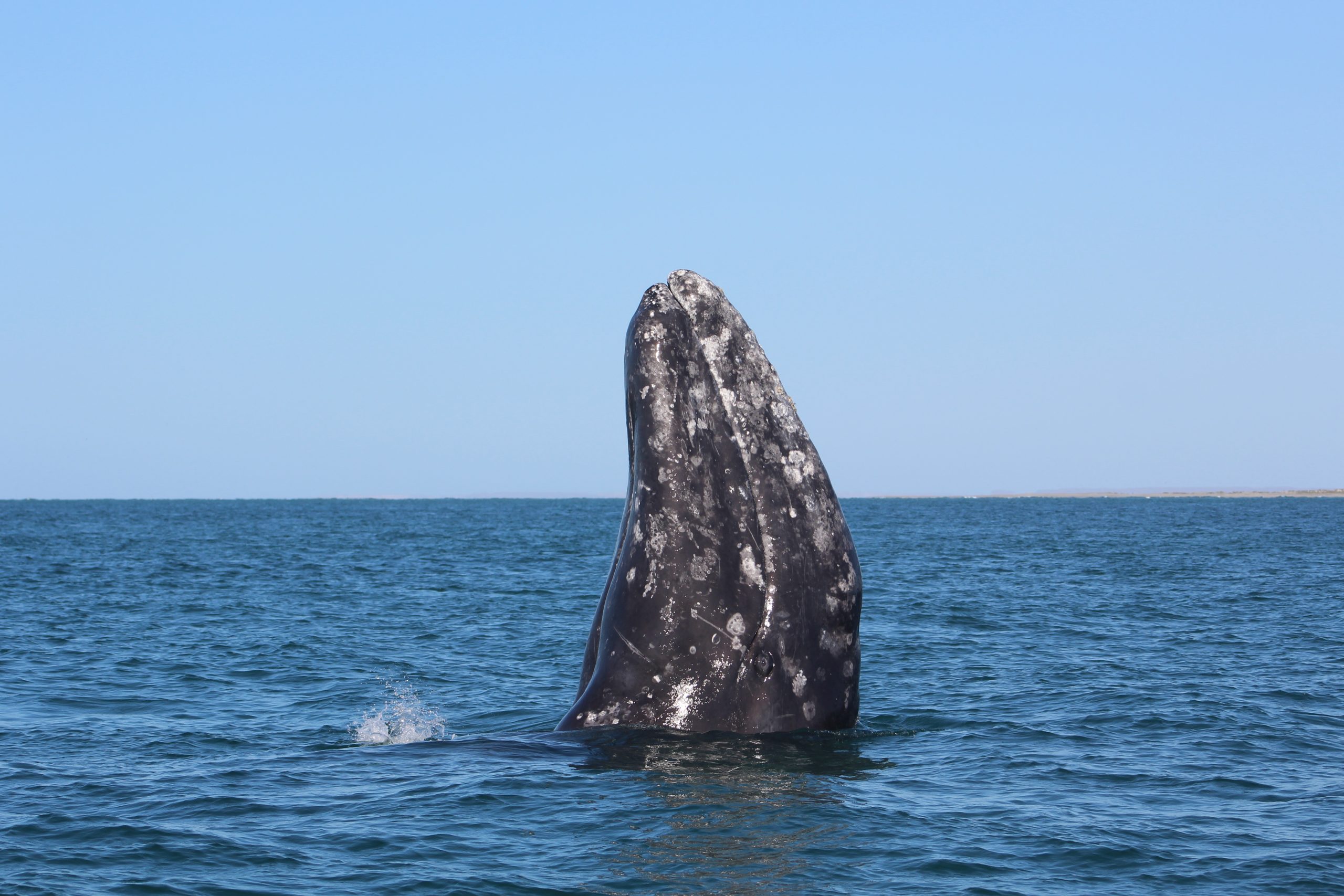
Gray Whales
Eschrichtius robustusThe gray whale (Eschrichtius robustus) is a bottom-feeding baleen whale and the only living member of its family. It makes one of the longest migrations of any mammal – and a small group, the Sounders, detours into Puget Sound each spring to feed.
Since 2018, eastern North Pacific gray whales have been caught in an unprecedented die-off. An Unusual Mortality Event (UME) was declared in 2019 and officially closed at the end of 2023 – but the decline hasn’t stopped. Strandings have continued at high numbers through 2025 and 2026, calf counts are at record lows, and the population has fallen to its lowest level since the 1970s.
As of 06/16/2026, 28 dead gray whales have stranded in Washington waters this year. (See the running stranding list →)
You can help right now: if you see a whale of any species, report your sighting. On the water, give struggling whales extra space – well beyond the 100-yard minimum. And support the organizations tracking and advocating for them.

Meet the Gray Whale
Biology and Natural History
Gray whales are unique in many ways. They have no living relatives – they are the only members of their genus Eschrichtius and their family Eschrichtiidae. They are the only whale species that primarily bottom-feeds on shrimp and small crustaceans living in the mud. They have a symbiotic relationship with species of barnacle and whale lice that are found nowhere else in the world.
Migration & Populations
Eastern Pacific, or California, gray whales undertake one of the longest migrations of any mammal — up to 12,000 miles round trip or more each year. Most spend their winters in and around the breeding grounds of Baja, Mexico, and their summers feeding on amphipods in the Bering, Chukchi, and Beaufort Seas. But the species is more varied than that single route suggests: distinct groups have carved out their own feeding strategies, and some individuals wander far beyond the expected range.
Eastern Pacific Gray Whale
The eastern North Pacific population is the one most people picture: the classic 12,000-mile migration between the Baja lagoons and the Arctic feeding grounds. It is by far the largest gray whale population and the one most affected by the current die-off.
Sounders
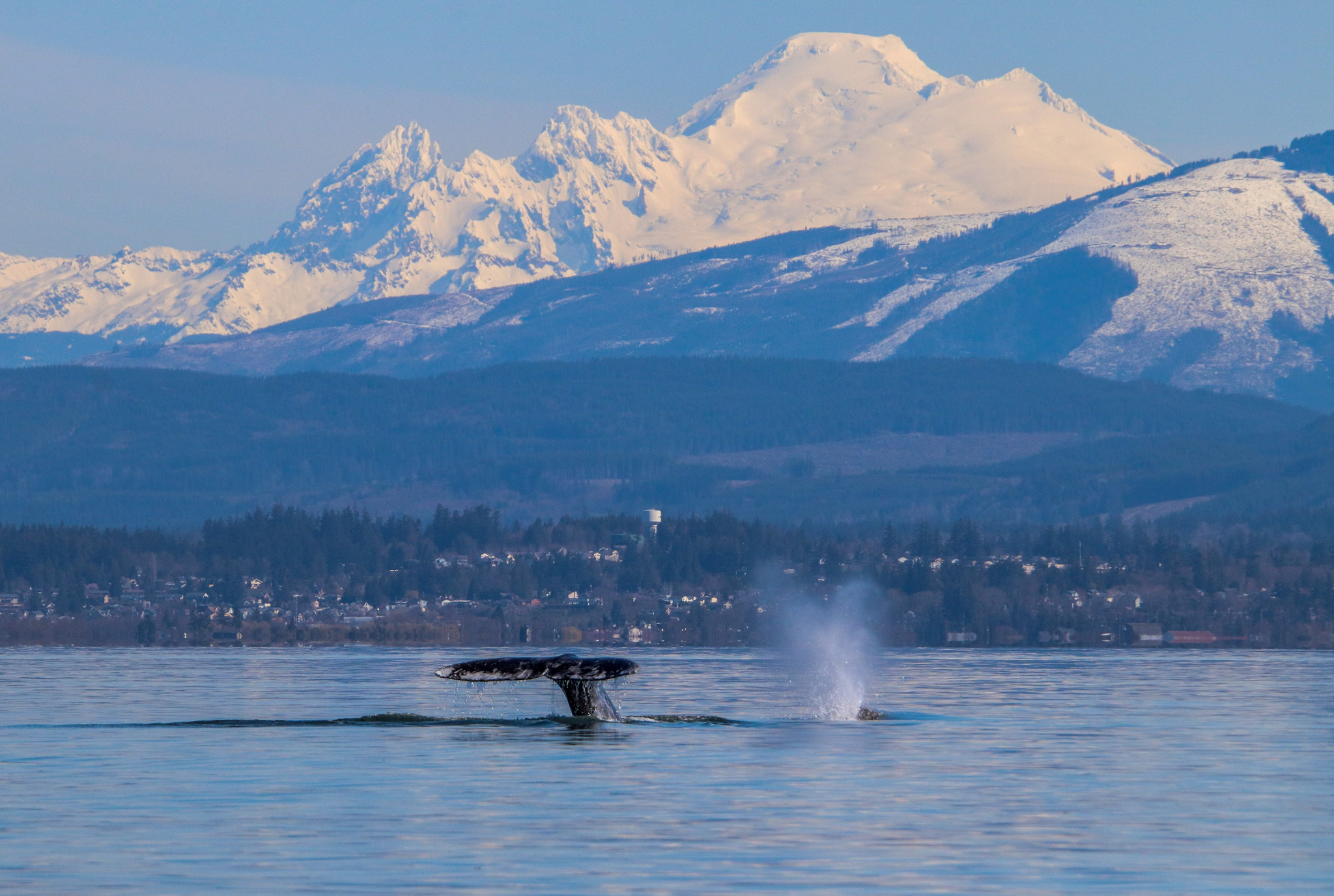
A special group of gray whales breaks off from the northern migration and detours to feed in North Puget Sound. Fondly known as the “Sounders,” they initially numbered roughly a dozen whales – part of the larger eastern North Pacific population – who came to feed on ghost shrimp each spring before continuing north to the Bering and Chukchi Seas. While that general pattern still holds, in recent years some whales have been arriving earlier or staying longer, and new individuals have joined the Sounders, both from the Pacific Coast Feeding Group and the wider gray whale population. Some Sounders have even chosen to forgo the migration to Baja and instead returned to Puget Sound in December to feed – an indication of the ongoing prey decline in the Arctic.
Currently about 24 Sounders meet the criteria of returning to the North Puget Sound feeding area for at least two years. The original Sounders appear to have discovered this area in 1990–1991, with additional whales arriving in 1999–2000 and again starting in 2018–2019. These periods coincide with Unusual Mortality Events, and appear to be when whales were branching out and searching for new food sources. None of the known females have been seen in Puget Sound with a calf, but periodic gaps in their presence suggest they are giving birth in the breeding grounds and simply not bringing their calves here – perhaps due to later migration timing after calving, or to avoid risk to the calf in the shallow intertidal feeding areas.
Pacific Coast Feeding Group
The Pacific Coast Feeding Group (PCFG) is made up of 200–250 individual gray whales that feed off the coast from Northern California to British Columbia rather than migrating to Arctic waters for the summer. They feed on a variety of prey, the majority of it mysid shrimp. PCFG whales are considered genetically distinct from the broader eastern Pacific population through their mitochondrial (maternal) DNA. This is likely because new whales are generally recruited into the PCFG as calves who learn the feeding grounds from their mothers – in other words, wherever mom takes you as a calf is likely where you’ll return to feed each year.
Western Gray Whales
Western gray whales are a small population of roughly 250 individuals, listed as endangered by the International Union for Conservation of Nature (IUCN). Heavily hunted during the commercial whaling era, they were thought to be extinct until the 1970s. Their main feeding grounds are off the Kamchatka Peninsula and Sakhalin Island, Russia, where oil development has raised concerns about disturbance and displacement. Until recently their breeding grounds were largely unknown, presumed to lie somewhere around the South China Sea.
Then satellite tagging studies in 2010 and 2011 led to an astonishing discovery: at least some of these individuals cross the North Pacific and join the migration of eastern Pacific gray whales. One tagged whale, Varvara, was tracked all the way to the Baja lagoons and back to Sakhalin Island – a round trip of 14,000 miles, the longest known migration of any mammal. Photo-identification has since confirmed more than 50 matches of western gray whales migrating to Baja, raising real questions about their status and whether they are truly a separate population:
- Did western gray whales begin exploring for new feeding grounds and eventually join the eastern migration?
- Did western gray whales in fact go extinct, with the habitat then filled by eastern gray whales who found the grounds off Sakhalin and Kamchatka?
- Is there still a remnant population of western gray whales traveling south to unknown breeding grounds, intermixing with eastern grays on the feeding grounds?
For now, the answers remain unknown. A few gray whale strandings off Japan and China in the past decade tell us at least some whales are continuing the presumed western migration – but much more research is needed to understand what is happening with this population.
Wandering Gray Whales
Gray whales are adaptive, curious animals that will often explore and roam into new habitats:
- In 2010, a gray whale was seen off Israel and later off the coast of Spain. It is presumed this whale entered the Atlantic through an ice-free Arctic – the first instance of a gray whale in the Atlantic in over three centuries.
- In 2013, a gray whale was seen off Namibia, the first ever spotted in the Southern Hemisphere. The individual stayed for two months, giving scientists a chance to collect DNA, and was later identified as an endangered western gray whale.
- In 2021, a young, malnourished gray whale was seen off the coast of Italy – the first record in Italian waters and only the second in the Mediterranean Sea.
- In 2023, a gray whale was identified off Kona, Hawaiʻi.
- In 2024, a gray whale was seen off Miami, Florida, and again a few months later off Massachusetts. This individual appeared to be in better body condition than the vagrant gray whales of previous years.
Friendly Gray Whales in Baja
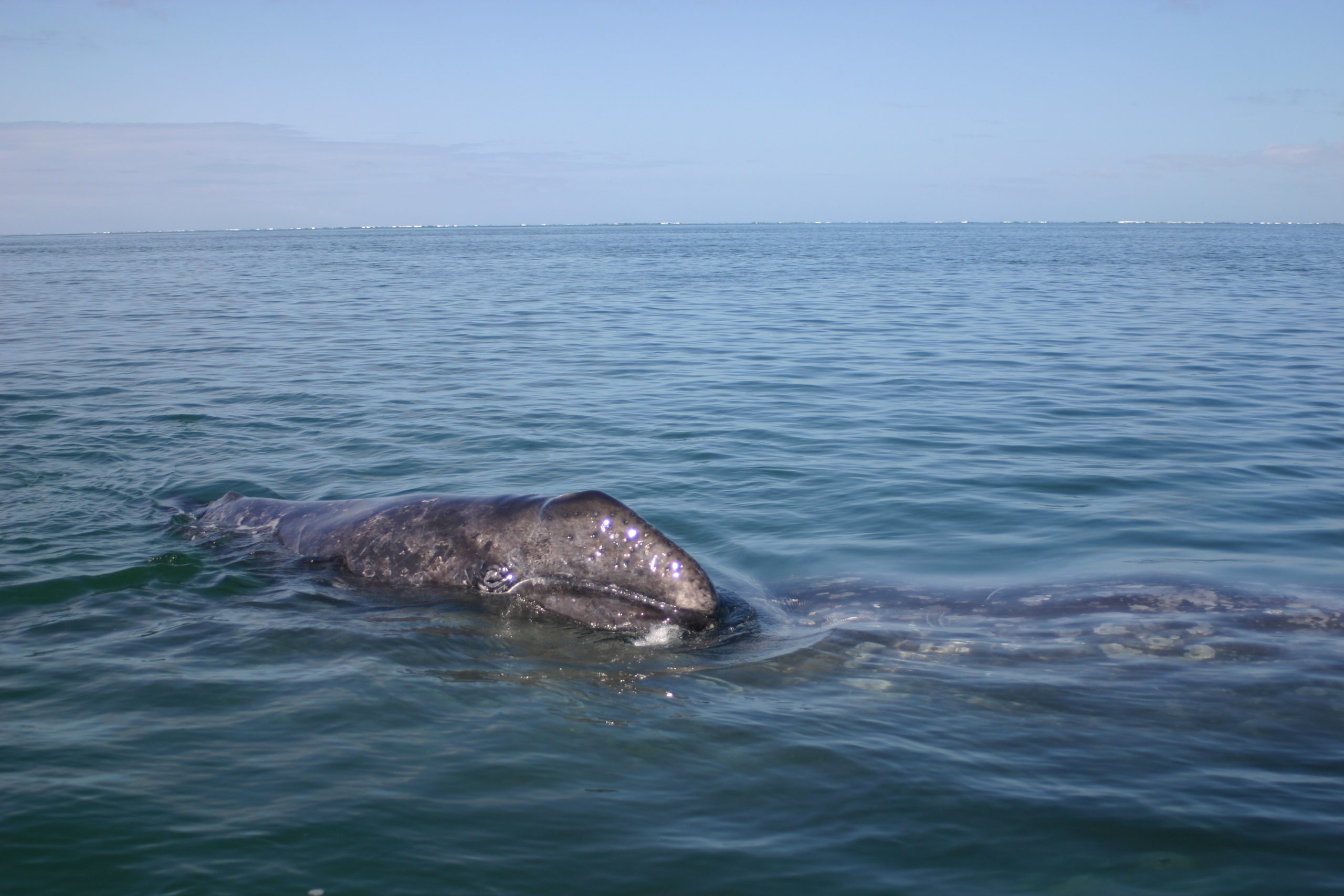
Not all gray whales in the wintering lagoons of Baja are “friendly,” but some do approach boats with curiosity and even allow themselves to be touched. We don’t fully know why, but it may be a combination of factors: the lagoons are likely seen as a safe place, free from predation and harassment; the whales are inquisitive by nature, particularly the calves; and they are acoustic animals whose calls resemble the sounds of the local whale-watching pangas’ outboard motors.
Laguna San Ignacio is a quadruply protected area – designated a migratory bird sanctuary, a whale sanctuary, a UNESCO World Heritage Site, and part of the Vizcaíno Biosphere Reserve. It was the subject of an intense environmental campaign in the 1990s, when the Mexican government and Mitsubishi planned to build the world’s largest salt factory along its shores. The campaign – led by organizations including NRDC and IFAW, with support from local people – succeeded, and the lagoon remains protected and untouched by industry to this day. San Ignacio has since become a leader in best practices for gray whale viewing, with limits on boat numbers and time, and a designated whale-watching zone. Operators do not chase or harass the whales; they position the pangas and let the whales approach if they choose to.
The Crisis: Gray Whale Status
Historically, there was a population of gray whales in the Atlantic Ocean, but they were hunted to extinction by the 1700s. Eastern Pacific gray whales were also hunted almost to extinction, and were one of the original species protected by the International Whaling Commission. In 1994, they became the first whale species removed from the U.S. Endangered Species List, hailed as one of the great conservation success stories of our time. But their road since then has not been an easy one.
Unusual Mortality Event
Since 2018, gray whales have been experiencing an unprecedented die-off. An Unusual Mortality Event (UME) was declared in 2019 and closed at the end of 2023, but the decline has continued. In addition to high mortality, the organization Gray Whale Research in Mexico reports that the UME has been characterized by record-low calf counts in the lagoons of Baja California. Only 85 calves were estimated migrating north in 2025 – the lowest count since records began in 1994.
In a 2025 population estimate, NOAA stated that the gray whale population had declined by approximately 53% since 2016, to about 12,900 individuals – the lowest population number since the 1970s.
2026 Sightings and Strandings
As of 06/21/26, there have been 30 gray whale strandings in Washington. Malnutrition or poor body condition was noted in 16 of those whales, and 10 were determined or suspected to be victims of trauma – though not all could be necropsied due to decomposition or location.
This ongoing die-off has also driven an increase in skinny individuals entering the Salish Sea in search of food. A few have found the Sounders and the ghost-shrimp food source; others have been seen feeding in additional locations. CRC53 Little Patch, known for his early arrivals, was first seen off British Columbia’s Sunshine Coast in late November 2025 before reaching North Puget Sound on December 11. He was joined later that month by three others – CRC531 Gretchen, CRC2440 Tahoma, and CRC2246 Azulão – an unusual number of December arrivals. Three new whales were given IDs after arriving in Puget Sound, and at least two joined the Sounders in the North Puget Sound feeding areas. There have also been sightings of grays elsewhere in Washington, outside the typical feeding areas, including northwest Whidbey Island, north Admiralty Inlet, Discovery Bay, Burrows Bay, Bellingham Bay, and even the Swinomish Channel.
Orca Network’s Whale Sighting Network has been tracking several emaciated gray whales around Central and South Puget Sound. These whales are in poor body condition and often end up in narrow waterways outside the typical feeding areas. Although they may be observed attempting to feed, there is often not enough food there for them to recover. In these situations, the best thing we can do is avoid adding stress. We encourage boaters to give these whales extra space – beyond the 100-yard minimum distance – or to not view them from the water at all. Our Whale Sighting Network also collects and shares sightings with researchers, NOAA/WDFW enforcement, and large commercial vessels including Washington State Ferries, to help keep whales safe in the busy waterways of Puget Sound.
What is causing the gray whale population decline?
A paper published in 2023 found that gray whales have experienced at least three major population declines since 1987, each coinciding with reduced numbers of the invertebrates they prey on. The recent UME almost certainly included an element of climate-driven change in the Arctic. An additional 2025 paper by Joshua Stewart et al. found that a rapidly warming ocean has reduced sea ice and increased the northward transport of Pacific water through the Bering Strait, affecting prey quality and availability in the sub-Arctic and Arctic feeding grounds. Interestingly, Arctic warming and sea-ice loss originally benefited gray whales by increasing their access to feeding areas – but that short-term gain is no longer enough to offset a rapidly declining food source.
When gray whales don’t get enough prey over the summer to build up their blubber layer, they may still make it to the Baja breeding areas, but lack the fuel to make it back to the feeding grounds. This is why so many strandings occur during the northward migration, and why so many additional gray whales have entered the Salish Sea searching for food.
Signs of this devastating mortality event are being seen throughout the North Pacific. During the official years of the UME (2019–2023), 690 dead gray whales stranded along the migration route from Baja to Alaska, and that number has continued to climb. It’s important to note that stranded whales represent only a small fraction of actual mortality – the majority never wash ashore. Researchers in the Baja breeding lagoons have recorded rising percentages of malnourished or emaciated whales alongside dramatically decreased calf production. In May and June 2025 – a time of year when gray whales would normally have left the lagoons for the northern migration – 60 individuals remained in the Bahía Magdalena complex feeding on red crab, most of them in poor body condition.
Further north, the Marine Mammal Center reported that 21 gray whales died in the San Francisco Bay area in 2025 – the highest number since the previous gray whale UME in 2000. Tragically, many were victims of ship strikes as they attempted to forage on new food sources in the face of declining prey elsewhere.
There have also been changes within the Sounders population of North Puget Sound. Having originally found the Puget Sound ghost shrimp during previous UMEs, the Sounders traditionally arrived in spring as a feeding detour on their way north. But the most recent UME has brought new recruits and more time spent in Puget Sound, including several individuals who have arrived in winter for the past few years and seemingly chosen not to migrate to the breeding grounds at all. This ghost-shrimp resource has become vitally important, and may have saved the lives of many Sounders during this period of scarcity. Sadly, we have also lost some beloved individuals in recent years, including CRC21 Shackleton, CRC44 Dubknuck, CRC49 Patch, CRC723 Lucyfer, and CRC2259. While we will never know a definitive cause of death for most of them, Cascadia Research Collective reported that 2259 was a victim of ship strike in San Francisco Bay, and was in good body condition at the time of his death.
Is There Hope for Gray Whales?
Gray whales are incredibly tough, adaptive animals – their scientific name is Eschrichtius robustus for a reason. They have survived and fully recovered from Unusual Mortality Events before. This one, however, is different: Dr. Sue Moore has described it as an unusual Unusual Mortality Event, because it has lasted longer than previous events and includes a continued decline and record-low calf counts.
But they are showing signs of adapting, at least on a small scale. They’ve been seen feeding in new areas and on novel prey – skim-feeding alongside bowhead whales in the Arctic, feeding on herring roe in Alaska, lunge-feeding on sardines off California, and feeding on red crab in Bahía Magdalena, Mexico. The Puget Sound Sounders and the Pacific Coast Feeding Group are themselves examples of successful alternate feeding strategies. Some of these adaptations, however, can put whales in greater danger from other threats – such as ship strikes, as seen in San Francisco Bay.
Solving the climate crisis is a daunting task and won’t happen quickly. But protecting some of these alternate feeding areas can deliver real, near-term benefits for gray whales.
How You Can Help
- Reduce your carbon footprint. Drive less by carpooling, biking, or taking public transportation whenever possible, and minimize your use of fossil fuels.
- Be a responsible consumer. Buy local whenever possible to reduce the carbon footprint of shipping, and look for eco-friendly alternatives to the goods and services you purchase. A few examples:
- Better World Club is a carbon-neutral alternative to AAA that donates funds to environmental organizations.
- When you travel, offset your footprint with carbon credits – e.g. Terrapass or the UN Carbon Offset Platform.
- Buy secondhand or repair before buying new – it keeps goods out of the landfill and cuts manufacturing emissions.
- Clean a beach. Gray whales are bottom feeders that sift through the mud for prey, and they sometimes feed in shallow intertidal waters. Keeping our beaches clear of plastics and debris helps provide a safe, healthy environment for them.
- Donate time or funds. Many nonprofits — such as Orca Network, Cascadia Research Collective, and Gray Whale Research in Mexico — collect data, educate, and advocate for gray whales. Others work on climate change directly, including NRDC and Earthjustice.
- Report whale sightings. If you see a whale of any species, report your sighting to Orca Network (or a network in your area) so the information can be shared with researchers and mariners.
- Be Whale Wise. If you’re a boater, know the regulations and guidelines in your area, learn how to minimize your impact on the water, and if you see a blow, go slow.
- Get involved in advocacy for gray whales and the protection of their foraging grounds. Follow Orca Network’s social media and check back here for action alerts.
- Learn more. Read Gray Whales of the Salish Sea for a deeper look at the whales and the issues they face.
- Spread the word. Share information about gray whales with friends, family, and colleagues, and help raise awareness.